
HERE TO STAY
TRIBUTE ACTS - NO LONGER JUST COPIES

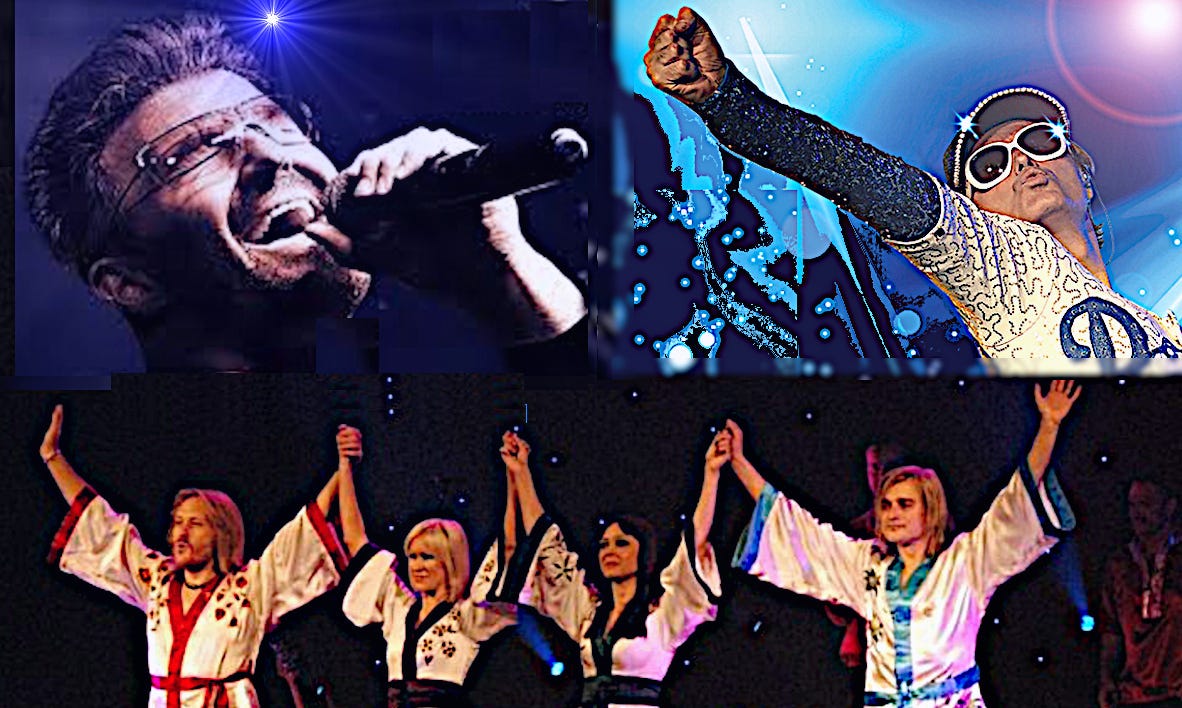
We used to think of tribute bands as fakes — the knock-off handbags of rock. Now they’re cultural heritage workers, keeping rock’s repertoire in circulation while the original artists rest or disintegrate. Every summer, festivals fill with second-hand legends - counterfeit Stones, imitation Zeppelins, simulated ABBAs. And no one laughs. They sing along.
Somewhere along the way, the cover band stopped being a guilty pleasure and became an acceptable form of live music. And critics no longer sneer. Björn Again appear at Glastonbury, The Bootleg Beatles tour with symphony orchestras, Lez Zeppelin sell out rock halls. These bands aren’t parasites; they’re caretakers — preserving repertoire that still matters but can no longer be delivered by its creators. We’ve entered an age when the cover version is conservation.
Twelve years ago, Harry Cowell and I had this in mind when we started our show Raiding The Rock Vault in Las Vegas. A tribute to rock itself, some of the world’s greatest rock stars playing two hours of the best-known rock tunes. It was a rotating band – the best musicians available when they weren’t on tour. For instance, on guitar we’d have Doug Aldrich from Whitesnake, until the band went on tour, then we’d bring in Tracii Guns, or Howard Leese. And so on. The show has run for 12 years, moving from the old Las Vegas Hilton, to the Tropicana, to the Hard Rock. Now we’re going to leave Vegas and put it on the road, along with some other great tribute bands.
Cover bands franchise nostalgia. They turn our communal memories into a live event. You can’t hire Fleetwood Mac for your local festival, but you can get Fleetwood Bac, and they’ll hit every harmony dead on. They offer the illusion of continuity, music that doesn’t age.
Ten years ago, George Michael sadly died. But miraculously you can still watch him perform if you go to see a show by Rob Lamberti who captures not just his look and his vocal timbre, but the pain in his soul.
Likewise, Jason Paris with his recreation of Elton John’s younger self in When Rock Was Young. And while the Rolling Stones may never tour your town, The Rolling Clones may do — and perform with indistinguishable swagger and showmanship. As do The Australian Pink Floyd, the brilliant Iron Maidens, and the much-respected Duran. What began as pastiche has evolved into preservation. The modern world has national parks and UNESCO lists for architecture; tribute bands are also cultural heritage — living museums of pop.
In classical music, all this was settled long ago. Nobody sneers at the Vienna Philharmonic for not writing their own material. They exist to serve composers who’ve been dead for centuries. Every year they replay the same notes and sell out the same halls. Yet every conductor, every soloist, adds something imperceptibly new.
Rock is now discovering what classical music always knew – great art endures through its interpreters. Tribute acts are adopting the role. The Analogues perform entire late-period Beatles albums that the band never played live, right down to the tape loops and mellotrons. Get The Led Out replicate studio overdubs Zeppelin never dared attempt on stage. In both cases, the copy expands the original, not diminishes it. And as in classical, where we accept that concert pianist Daniil Trifonov plays Rachmaninoff at least as well as the composer did himself, perhaps Steph Paynes of Lez Zeppelin should be seen as an equal of Jimmy Page.
Tribute acts expose the frailty of perfection – the truth of live performance. They let the songs breathe again.They also keep musicianship alive. While megastars huddle in planning sessions with producers of multi-million dollar hologram shows, tribute players are still tuning guitars and sweating on real stages. They preserve ensemble skills — timing, blend, restraint — things modern pop, with its laptops and click tracks, barely remembers.
A good tribute act lives in the space between illusion and respect. It’s not just being note-perfect, it’s a musical communion with the past. Some embrace parody, like Lez Zeppelin. Others pursue forensic accuracy, like The Bootleg Beatles. Either way, it’s theatre, not deceit. The costume completes the ritual. As well as hearing it, your eyes want a chance to remember it too – a flash of sequins, a wig, a familiar silhouette — the visual chord that unlocks memory. And for the players, it’s liberating. The ego dissolves. To step into another’s shoes is a humility rare in pop. In the tribute act, the self is secondary to the song. They’re professional interpreters, keeping the flame burning while the gods retire to their villas.
The cover version isn’t the enemy of originality; it’s the proof of it. No one covers mediocrity. Great songs demand repetition. A tune that survives a thousand reinventions isn’t diminished; it’s canonised.
And for the audience, that’s the point. Tribute acts restore what recordings can’t — the human scale of music. That’s why 50,000 people fill arenas to hear Bjorn Again, or The Australian Pink Floyd. Or see The Bootleg Beatles performing A Day in the Life, a song the real Beatles never played live.
It’s not a hologram. It’s not a fake. It’s human beings making grand, thrilling beautiful noise. Live. In front of them. With real instruments.
SUBSCRIBE FOR FREE BELOW - AND RECEIVE REGULAR POSTS
Perfect Article Simon. Cloudbusting, the Kate Bush Tribute Band are Wonderful and always respectful to the music - I have guested with them playing some songs we did with Kate and it is always a thrill. Younger people who never had a chance to see Kate live as when we played with her on The Tour Of Life are quite Thrilled by the experience. Thanks Preston Heyman
Covering a song and impersonating it are two different things. Nobody dresses as a Paganini performing his music or dons a wig while playing Mozart. George Michael once said singing covers is his way of taking a break from himself, that it's like singing his own karaoke. The only part I cannot really connect with is tribute acts impersonating the artist. The more someone tries to look like G the more one notices the differences. It's almost an uncanny valley effect. He's there but he's not there. It's like dating a look alike of Hugh Grant. ABBA or Whitney are like summoning ghosts (of the loved and lost ones), GM Singers are the real stuff without the main part. As usual - thank you for your post - excellent, thought provoking read.