
BEBOP
THE VOICE AND THE ECHO

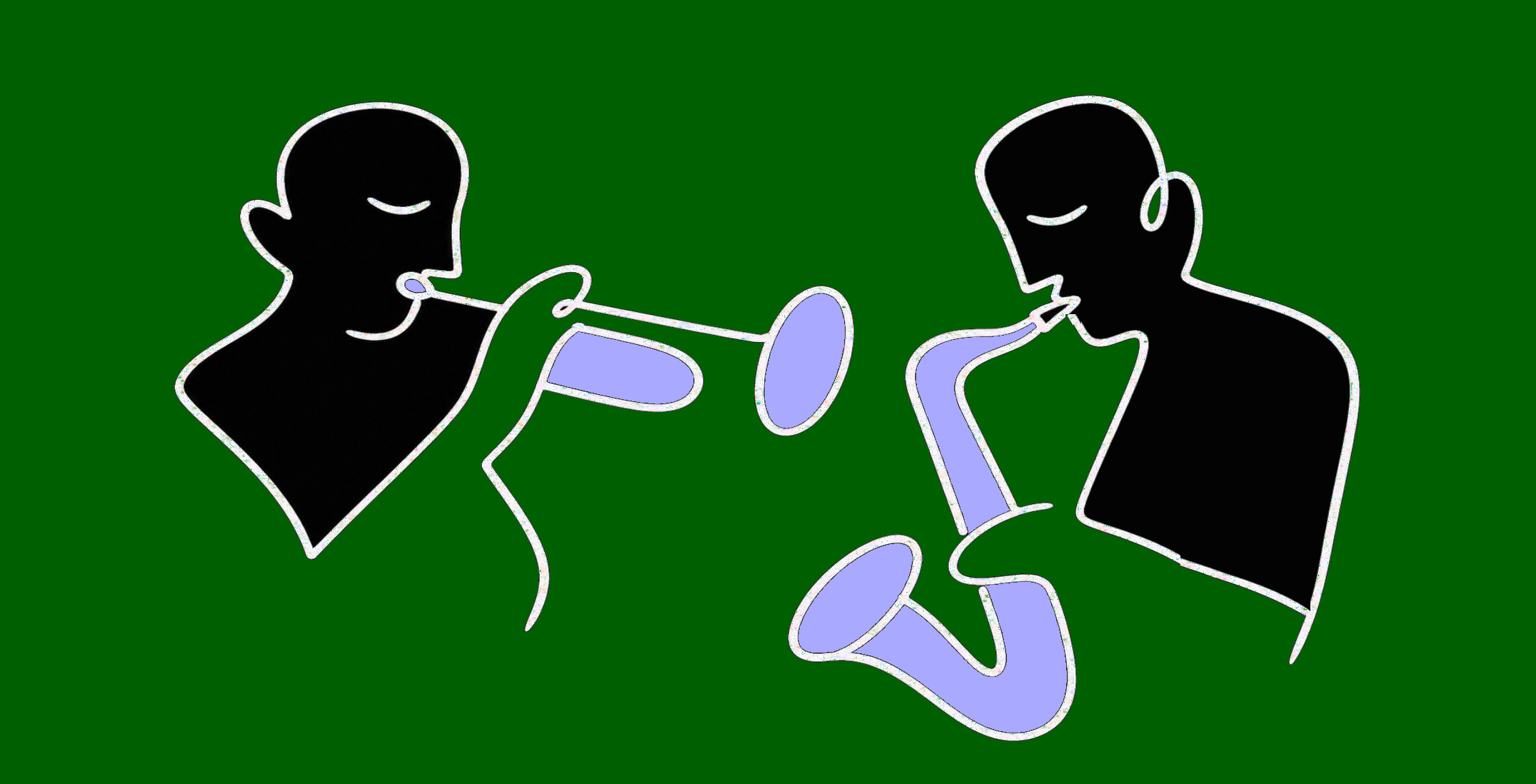
The other day I had a pleasant exchange with the once prickly Rolling Stone rock critic John Mendelsohn — much softened, it seems, by English married life and an additional “s” he’s had added to his surname. But when I mentioned bebop, the prickles returned. Listening to it, he said, made him “more exhausted than uplifted.” Which is a pity.
One thing a lot of people don’t get about bebop — even those who love it — is that it used the untidiness of human speech as the basis for improvisation. People talk about bebop as though it were primarily a revolution in harmony. What really changed was the phrasing. It was the rhythm of Black American street talk, circa 1940.
Dizzy Gillespie delighted in starting phrases in unexpected places, interrupting bar lines rather than obeying them, and sailing blithely across the boundaries of eight-bar sections. When Dexter Gordon and Wardell Gray traded choruses on The Chase, the original song was just an excuse for them to joke and argue for twenty minutes in a flow of Black vernacular.
Charlie Parker’s solos often sounded like someone talking to themselves — an intense flow of speech, darting ahead of the beat, then falling behind it, breaking off unexpectedly and resuming somewhere else entirely. He could be funny, aggressive, and slightly unhinged — like he’d woken up at three in the morning and was running through all the things he should have said in an argument earlier in the day. Anger and rhythm banging against each other, the drums echoing Parker’s every accent and cadence.
But between this conversational phrasing and the rhythmic structure on which it sat, bebop sometimes had a conflict. The popular songs that served as vehicles for bebop solos came from Tin Pan Alley — carefully balanced melodies built in symmetrical structures. The phrasing of their lyrics was first and foremost musical — too artfully shaped to feel like normal speech. Singers faced the problem of making them sound conversational.
Frank Sinatra was the best. He was the master of rubato — bending the timing, delaying syllables, stretching some words, dancing over others. He loosened the written rhythm until it seemed as if he was speaking with you privately.
Billie Holiday went further still. She bent melodies out of shape, then rebuilt them around spoken rhythms. The written tune would play beneath her but she wasn’t tied to it.
Bebop’s improvisation flowed over these same songs, but with greater freedom than singers could enjoy. Melodic phrases swung between two extremes — the loose rhythms of human speech, as sung in the blues or with small-combo jazz, or the formal patterns of written composition, as in musical theatre and the Great American Songbook.
Bebop intruded on the side of speech. In 1940, in the middle of the swing era, when popular music was at its most polished and symmetrical, it barged in with an asymmetric flow of Black American vernacular — humorous and argumentative – changing forever the phrasing of jazz solos. But that wasn’t the end of the story.
Speech has bad habits. People repeat themselves. They develop favourite turns of phrase and start finishing one another’s sentences. Before long, bebop did the same. What began as spontaneous conversation started to sound like a group of people who’d heard each other’s jokes too many times. By 1950, you could buy a book of “500 Favourite Bebop Licks.” Musicians no longer spoke to each other when they played solos, they quoted famous phrases at each other.
Which is where Miles Davis came in. He’d been around for years, but it was his shift in approach that mattered. He became increasingly disgruntled with bebop’s frantic chatter, so he waved it goodbye and took the opposite path. While others used the phraseology of conversation, he adopted the phraseology of thought. He left holes and let phrases hang unfinished. Sometimes, he just played a single note, testing whether another one was necessary. There was a refusal to be pressured, and there was no showing off. Miles’s phrases didn’t behave like arguments — they left space while he considered things. As one critic put it, he was “elegantly introspective.” And interestingly, he cited Frank Sinatra as an influence.
This week Sonny Rollins died. Aged 92, he belonged to the last generation of great bebop musicians. To hear him play was to listen to someone express themselves with the authority of an original. But to hear bebop played by young bands who recreate its original 1940s style, however immaculately they play, is simply a reminder of how easily sparkling conversation can collapse into mindless chatter — a litany of favourite licks, the original book of 500 phrases having been joined by hundreds of publications teaching every cliché, variation and turn of phrase ever played in the style.
So maybe John Mendelssohn was right — bebop today has no validity as art, it’s just a high-class party trick that evokes a bygone era, not something that really matters.
Miles Davis, of course, worked that out fifty years ago.
FREE UPDATES EVERY WEEK
CLICK SUBSCRIBE AND LEAVE YIUR NAME
Miles Davis’s and Sinatra strong influences .sinartra with his immaculate phrasing and miles Davis with his modern grasp of space and abstraction
As if the initial column wasnt brilliant enough, the below exchange between you and JM is pure joy. I feel as if I've sneaked into a gentleman's club and am sat pretending to read whilst listening in to a private conversation. Ed Harcourt was right, the birds will sing for us...