
ROCK GUITAR
THE GREATEST?

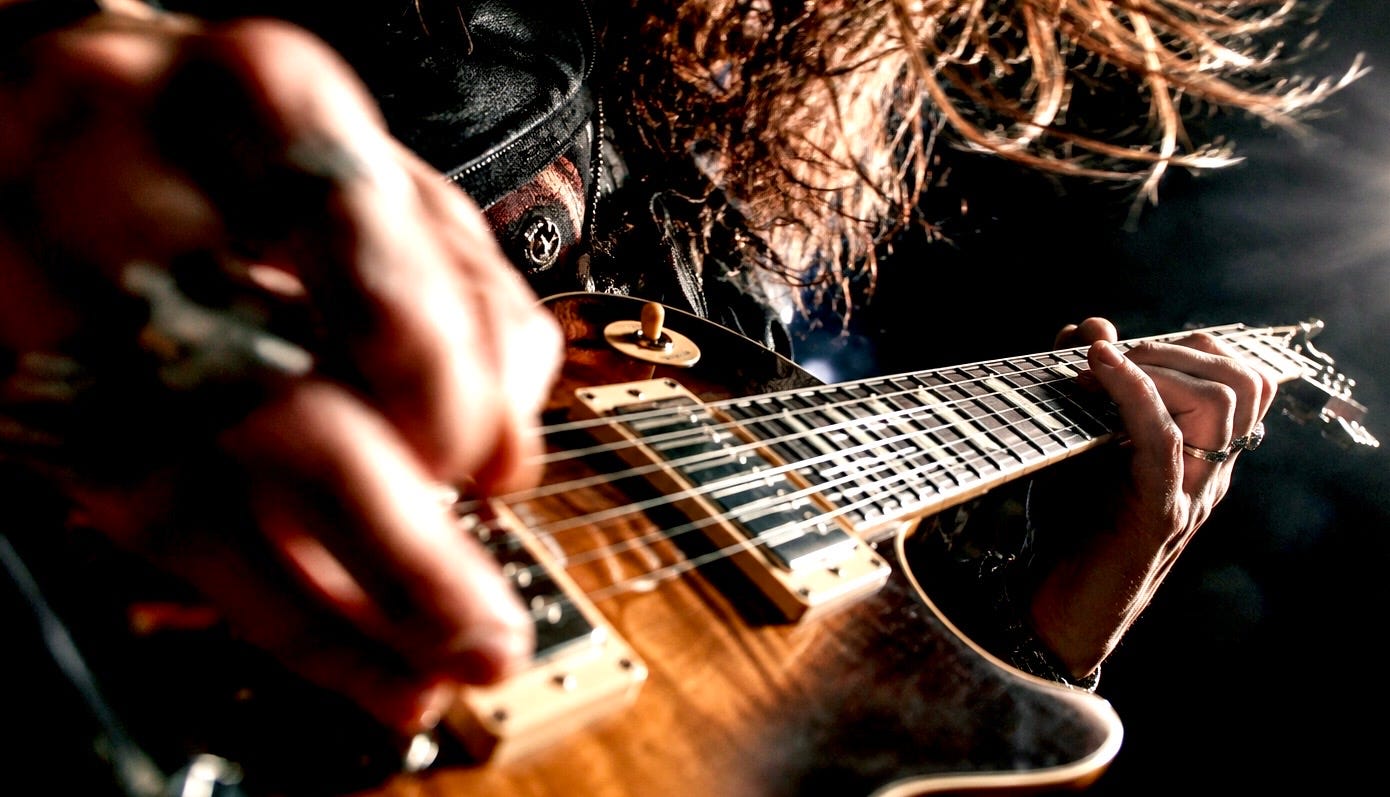
Last week, during an interview, I was asked, “Who was the greatest ever rock guitarist?”
The interviewer probably thought I’d say Jeff Beck, or Hendrix, or Jimmy Page. But I hesitated. I didn’t like the simplicity of the question. Because what exactly is great rock guitar?
Most discussions focus on virtuosity. Speed and technique. Or the ability to leave other guitarists open-mouthed. But rock music isn’t a guitar competition, it’s a group activity. The greatest guitarist, and the greatest rock guitarist, may not be the same thing.
During Manchester United’s peak years in the early 2000s, Cristiano Ronaldo was the dazzling match‑winner. But most insiders will tell you that Paul Scholes was the player who made things work. Ronaldo won games. Scholes was the centre of gravity.
Rock music is much the same. Its mythology is studded with virtuosos playing faster, louder and higher, Ronaldos every one of them ⏤ but there’s another role to be played, too.
A few weeks ago I saw Keith RIchards on an American talk show ⏤ an eighty-year-old man on a sofa. But it took just two chords strummed on his acoustic guitar and suddenly the Rolling Stones were in front of you, about to burst into Honky Tonk Women.
The Stones have had several lead guitarists ⏤ Brian Jones. Mick Taylor. Ronnie Wood ⏤ all excellent. But the character of the band has never changed. Which says it all. The group’s defining sound is in the riffs and the rhythm ⏤ in Keith Richard’s open tuning and the spaces between the notes ⏤ and the way his guitar colludes with Mick Jagger’s voice.
In the 1960s, I was lucky enough to manage the Yardbirds when both Jeff Beck and Jimmy Page played in the band. Shortly after Jimmy joined we went into Sound Techniques in Chelsea to record Stroll On for the film Blow Up. Jeff played the lead, Jimmy the rhythm. But the sound was a composite. And it’s some of the finest rhythm guitar you’ll ever hear.
Onstage, Jeff played things that seemed technically impossible. He’d roar into a solo like the start at Brands Hatch, then flow into feedback as pure as an alto flute. Jimmy was different. He stood listening to the whole band, figuring out what was needed to make it complete.
When he moved on to Led Zeppelin, he combined both roles; he wasn’t just the group’s virtuoso, he was the centre of synergy. Brilliant ⏤ but never more so than when he played rhythm to Jeff Beck’s lead.
Eric Clapton was an earlier Yardbirds guitarist. When he left to join Cream, he found himself at war with two giant egos ⏤ Ginger Baker and Jack Bruce. To find space between their jazz-mad bass and drums, he created a blues-driven, voice-like guitar, and each evening the three of them did battle. Not exactly rock. But great theatre.
Hendrix was theatre too, and his playing was sublime. In a single seamless flow, he combined lead and rhythm, bass-line and chords, feedback and harmonic overtones. He fretted with his teeth, played the instrument behind his back, and set it on fire.
Brilliant boasting. But it was a one-man show, as was often the case with virtuoso guitarists ⏤ Eddie Van Halen, Steve Howe, Prince, Gary Moore ⏤ each eager to show us what the guitar could do in their hands that it couldn’t do in others. Geniuses, all of them. But when you went to see their groups, were you going to see the band? Or the guitarist?
Which leads to the question ⏤ what is rock guitar actually about?
Sixty years of listening to rock brings me to just one answer ⏤ the greatest guitarists create the tightest band and are the nucleus of its sound. They don’t dominate. They don’t overwhelm. They’re the chassis. And when you start looking at guitarists in that light, a totally different list emerges.
Mark Knopfler doesn’t merely influence the sound of Dire Straits. It emanates from him. The touch, the phrasing, the tone, the restraint.
Malcolm Young did something similar with AC/DC. His brother Angus became one of rock’s great stars, but the engine was Malcolm. He supplied the riffs, the groove, and the concept. He wasn’t the decoration. He was the scaffolding.
And then there’s John Lennon and George Harrison. John was a brilliant rhythm guitarist, driving the Beatles with a force often overlooked. George Harrison was the most tasteful of decorators; never demanding attention. Both had egos, and later suffered from them, but within the Beatles they played with extraordinary balance and lack of competitiveness.
Brian May, too, was always a team player. And Pete Townshend ⏤ not the flashiest or fastest of players but the person who gave the Who its structure. He once described himself as “a rhythm guitarist who plays lead”. It’s a revealing phrase. The players who build great rock bands often think that way ⏤ they listen to the whole and add only what’s needed.
And that brings us back to Keith Richards. He’s often argued that rhythm guitar is the real art form. Lead guitar, he says, is largely in the fingers, but rhythm comes from the whole body. Which is why two chords on a talk show could instantly evoke a lifetime of Rolling Stones music.
This piece started with a journalist asking me, “Who was the greatest ever rock guitarist?” I should have told them at once: it’s an impossible question.
Rock greatness isn’t only what happens under the spotlight; it’s also what happens in the ensemble. And every ensemble is different. Listening just now to the Rolling Stones new album, I decided it was Keith Richards. But five minutes later I remembered David Gilmour. Then Alex Lifeson. Steve Vai. Bonnie Rait. Brent Mason. Tak Mutsumoto. John Mayer...
So you know what? I’ve decided the whole discussion is just too daft.
This piece isn’t going to have an ending.
FOR FREE WEEKLY UPDATES
CLICK SUBSCRIBE AND LEAVE YOUR EMAIL
And ill add Steve Jones, the power and glory, edge and attack of the Pistols
Stone Gossard. The anchor of Pearl Jam. The last time i saw PJ he stood far stage left, the guy barely even had a spotlight on him, and he was the foundation for everything.
Two more (slightly) unsung guitar giants:
Billy Duffy The Cult
Elliott Easton The Cars